Rasmala Announces $500 Million Poseidon Fund Exit

Poseidon Fund

Poseidon Fund delivers over 8x return to participating shareholders

Rasmala Investment Holdings (DIFC) Limited (“Rasmala” or “Rasmala Holdings”), an independent, alternative investment group, announced that Poseidon Fund (CEIC) Limited (“Poseidon Fund”), managed by its subsidiary Rasmala Investment Bank Limited (RIBL”), and regulated by the DFSA, has delivered a return of over 8x to its participating shareholders through an in-kind distribution, marking one of the group’s largest and most significant transactions in the last 24 months.

Poseidon Fund is a DIFC-based investment fund that was established to increase DFM-listed Gulf Navigation Holding PJSC’s (“GulfNav”) capital base and support its strategic growth initiatives. RIBL structured and managed GulfNav’s USD 59.9 million (AED 220 million) issuance of Mandatory Convertible Bonds (MCBs), which was then converted into 200 million ordinary shares of GulfNav at a price of AED 1.10 per share, turning Poseidon Fund into GulfNav’s largest shareholder.

The Fund’s investors included leading UAE-based family offices, high-net-worth individuals, and financial institutions. The exit coincides with GulfNav’s planned USD 871 million (AED 3.2 billion) acquisition of Brooge Energy Limited (“Brooge”).

Ali Taqi, CFA, Deputy CEO of Rasmala Investment Bank Limited, said:

“We are extremely pleased with the investor returns and successful transfer of shares, and I highly appreciate my team’s dedication in delivering this accomplished exit. The transaction showcases our expertise in structuring sophisticated deals and delivering bespoke investment solutions that support our clients’ growth ambitions. We see significant opportunity in extending growth capital to GCC-based companies and leveraging our deep understanding of both private and public markets to help them achieve their next stage of development.

GulfNav’s acquisition of Brooge remains on track for completion, following the signing of the Sale and Purchase Agreement in May and the successful $136 million MCB issuance in July. The transaction is expected to be settled through cash, new shares, and mandatory convertible bonds, with Brooge having delisted from Nasdaq as part of the process.

Rasmala Holdings

Rasmala Holdings is the parent company of RIBL, an independent alternative investment manager serving Gulf-based investors, including family offices, corporates, insurance companies, banks, and other financial institutions. RIBL is regulated by the DFSA.

Rasmala delivers robotics-enabled logistics facility in Netherlands

TimberlandNews

Distribution centre pre-leased for 15 years to a global outdoor fashion brand


Dubai, UAERasmala Investment Bank Limited (“Rasmala”), one of the leading Dubai-based alternative investment managers, announces the successful completion of its ground-up investment in a cutting-edge logistics facility in Almelo, Netherlands.

Built over 15 months, the project delivers a large, robotics-enabled distribution centre, built-to-suit, for a global outdoor fashion brand. This is Rasmala’s third investment in the Netherlands, expanding Rasmala’s European logistics portfolio with a de-risked, income-generating asset. The project demonstrates Rasmala’s capabilities to actively create value in cross-border investments.

“Delivering bespoke structures that help our clients achieve their investment objectives has been a key guiding principle of Rasmala for 25 years. This is a high-quality asset that benefits from a long-term, inflation-protected lease with a reputable tenant, offering a stable return, coupled with capital preservation,” said Ali Taqi, Rasmala’s Deputy CEO.

Project Highlights:

  • Asset Value: €38M+ prime logistics facility
  • Size: 312,000 sq. ft. with 25m height
  • Lease: 15-year term for a NYSE-listed global tenant, CPI-indexed rent
  • Location: XL Business Park, Almelo, a key European logistics corridor

The facility comprises a warehouse, an office, and a mezzanine area, with a total of 118 parking spaces. With advanced automation capabilities, the building achieved BREEAM Very Good certification and serves as a strategic EMEA distribution hub for its global tenant. The property is beside another Rasmala-managed warehouse leased to the same tenant.

Rasmala co-developed the site with GARBE Industrial Real Estate Netherlands from project inception, alongside the main contractor, Systabo. The team successfully navigated the complex cross-border structuring, regulatory, and development risks, actively managing the development process to ensure the timely delivery of a tailor-made facility that meets the sophisticated requirements of modern logistics.

The successful completion reinforces Rasmala’s unique capability among regional asset managers in originating and developing greenfield real estate investments in some of the most desirable European investment destinations.

About Rasmala: Operating from Dubai with global reach, Rasmala is an independent provider and manager of alternative investment products, serving Gulf-based investors, including pension funds, family offices, corporates, endowments, and financial institutions. Rasmala Investment Bank Limited is a wholly owned subsidiary of Rasmala Investment Holdings Limited. It is based in the Dubai International Financial Centre (“DIFC”) and regulated by the Dubai Financial Services Authority (“DFSA”).  

Media Contact

Tim Hydari

Senior Executive, Branding and Investor Communications

+971 56 406 6180

tim.hydari@rasmala.com

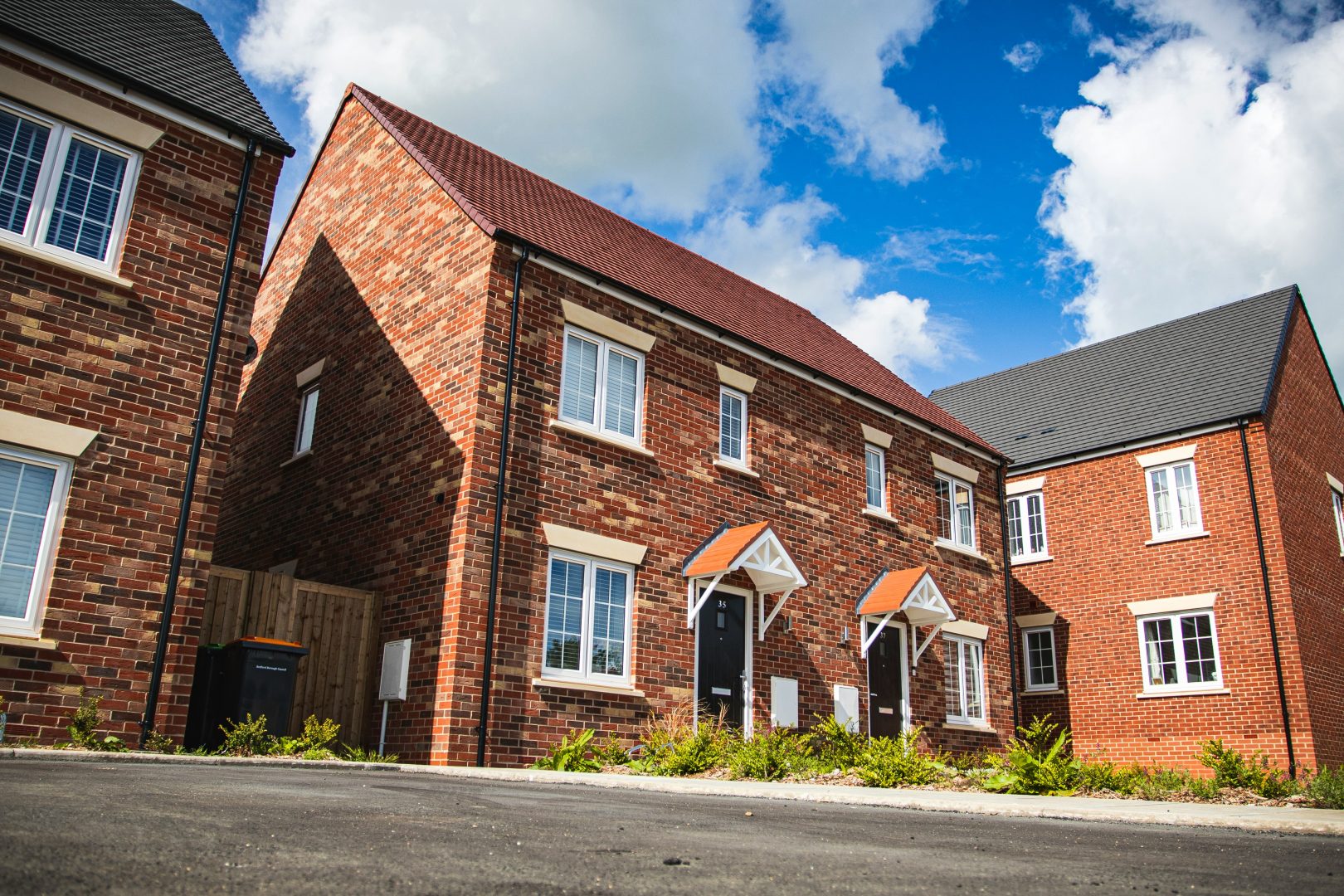
Can New UK Government Initiatives Address the Chronic Housing Shortage?

james feaver aB2yE2vdPRM unsplash

Key Initiatives Include National Housing Bank, Social and Affordable Homes Program, Planning and Infrastructure Bill 


Important: Rasmala Investment Bank Limited is regulated by the DFSA. This communication is for professional clients (DFSA) only and for informational purposes only. It does not constitute investment advice or an offer to buy or sell any security. It is not for retail distribution. Past performance is not indicative of future results. Investments carry risk, and values may fluctuate, falling as well as rising.


The UK housing market may present potential long-term investment opportunities due to a chronic undersupply of housing, which may underpin both income and capital values for investors. However, accessing attractively priced properties, particularly through greenfield and brownfield development, is hindered by government regulations and escalating construction costs, especially in regeneration areas. 

The UK Housing Crisis: A Deep-Rooted Imbalance 

The UK housing market faces a longstanding supply-demand imbalance with significant socio-economic consequences. The UK has a backlog of 4.3 million homes that accumulated between 1955 and 2015, a substantial deficit compared to the average European country.  

Despite efforts by agencies like Homes England, which reported 38,308 housing starts and 36,872 completions in 2024–25 and exceeded its internal targets for two consecutive years, broader national housing goals remain out of reach. This indicates a long-term, structural challenge rather than a temporary issue for investors.  

Affordability is a growing concern, particularly for renters. As of April 2025, private renters in England spent approximately 29.6% of their income on housing. While rising earnings have modestly improved affordability for buyers, rental costs continue to soar, especially in cities, pushing more households toward social housing. This divergence highlights growing pressure on the rental market and points to strong fundamentals in the Build-to-Rent and Single-Family Housing sectors, which may offer stable, inflation-linked returns and are less exposed to regulatory constraints affecting high-rise sales developments.  

Government Interventions: A Multi-Pronged Approach 

The UK government has launched a series of significant initiatives in 2025 to tackle the housing crisis, combining direct financial intervention, long-term funding certainty for affordable housing, and comprehensive planning reforms. These interventions aim to improve the investment environment by providing additional funding and streamlining processes.  

  • The National Housing Bank (NHB): A New Financial Lever 

Launched in June 2025, the National Housing Bank (NHB) is a crucial component of the government’s housing strategy. Backed by £16 billion in new public capital and £6 billion in existing funds, the NHB aims to deliver over 500,000 homes by partnering with the private sector and providing financial certainty to investors. This public support is expected to unlock up to £53 billion in private investment.  

Operating as a government-backed arm of Homes England, the NHB has the authority to issue guarantees and deploy capital directly. To reduce risk for private investors, it offers a full suite of financial tools, including equity, debt, and guarantees. Specifically, £2.5 billion will support affordable housing through low-interest loans, and SMEs will benefit from revolving credit and expanded partnerships with lenders. For investors, the NHB may offer co-investment opportunities in previously unviable projects, especially those involving regeneration, infrastructure, or SME builders. By absorbing early-stage risk, the NHB lowers barriers for private capital and creates new entry points into complex developments. However, investors should conduct thorough due diligence to understand how NHB-backed projects, which may benefit from subsidies or guarantees, could alter normal pricing dynamics and affect returns and market value.  

  • The Social and Affordable Homes Programme (SAHP): Long-Term Certainty 

 Published in July 2025, the £39 billion Social and Affordable Homes Programme (SAHP) aims to deliver 300,000 new affordable homes over 10 years, a scale twice that of its predecessor. At least 60% (180,000 homes) will be for social rent. From April 2026, social housing rents will be capped at the Consumer Price Index (CPI) plus 1% for a period of at least 5 years, providing long-term clarity for planning and reinvestment.  

The SAHP also reforms the Right to Buy scheme, extending tenant qualification periods, adjusting discounts, and exempting new social homes from sale for 35 years. It also aims to rebuild public sector delivery capacity by strengthening local authority borrowing, regulation, and partnerships. This 10-year funding and rent framework may offer investors a rare level of predictability, potentially reducing uncertainty and strengthening the appeal of affordable housing as a potentially stable, inflation-linked investment. A renewed focus on council-led housebuilding may open the door to more joint ventures between local authorities and private firms, potentially offering new opportunities for developers and investors with relevant delivery expertise.  

  • Planning and Infrastructure Bill: Streamlining Development

Introduced in March 2025, the Planning and Infrastructure Bill aims to streamline homebuilding and infrastructure delivery as part of the government’s target to build 1.5 million homes by 2029. Key reforms include reinstating mandatory housing targets (from December 2024), allowing development on ‘grey belt’ land (lower-quality green belt areas), simplifying regulations, reforming compulsory purchase processes, and enabling strategic, cross-boundary planning. While development on ‘grey belt’ land increases theoretical supply, it doesn’t eliminate local opposition. Investors may consider prioritising regions where local authorities support development and where strong community engagement strategies are in place to mitigate potential delays from community resistance.  

The Reality on the Ground: Persistent Delays and Their Impact 

Despite ambitious policy frameworks and significant financial commitments, the practical implementation of housing development in the UK is severely hampered by persistent and systemic delays. These bottlenecks, particularly those associated with the Building Safety Act (BSA) Gateway 2 approvals and the broader planning system, create considerable friction and risk for developers and investors.  

Building Safety Act (BSA) Gateway 2 Delays 

Gateway 2, introduced under the 2022 Building Safety Act, requires approval before construction begins on Higher-Risk Buildings (HRBs), typically high-rise residential projects. Developers must submit complete plans and safety documentation to the Building Safety Regulator (BSR), but the process has become a significant constraint. Delays persist primarily due to the complexity of new regulatory requirements and a high rate of defective applications. Applications are taking between 25 and 40 weeks, with some projects experiencing delays approaching 18 months, straining contractor pricing models and disrupting cash flow. This regulatory uncertainty has prompted many developers to scale back or avoid high-rise projects, reducing the pipeline where urban density is most needed. Even with NHB and SAHP financial backing, Gateway 2 remains a critical bottleneck, limiting housing delivery speed and scope. The main issue is that developers often fail to demonstrate compliance adequately, submitting plans that show what work will be done rather than proving how building regulations will be met. However, the BSR is working to provide more explicit guidance and advisory services.  

Planning System Delays 

Beyond the Building Safety Act, the broader planning system continues to present substantial obstacles. Applications that should theoretically take 8-12 weeks routinely stretch to nearly a year, creating cascading delays. Local resistance, or NIMBYism, compounds these procedural delays, even on land designated for development like ‘grey belt’ areas. This opposition can derail projects that have already navigated complex regulatory hurdles, creating additional uncertainty for investors and developers. The cumulative effect has been a sharp decline in housing starts as developers become increasingly reluctant to commit capital to projects with unpredictable timelines. For investors, this uncertainty may translate directly into extended risk exposure and compressed returns, often deterring capital deployment entirely.  

Investment Implications: Navigating Delays and Opportunities 

The confluence of ambitious government housing initiatives and persistent development delays creates a unique landscape for real estate investment. Understanding these dynamics is crucial for identifying strategic opportunities while mitigating execution risks. While government capital is increasingly abundant, delivery remains constrained by regulatory bottlenecks, making execution risk the central investment consideration.  

Strategic Opportunities 

  • Target low-regulation segments: With high-rise projects facing severe regulatory delays, investor focus is shifting toward Single-Family Housing (SFH) and certain Build-to-Rent (BtR) models, which may offer faster delivery timelines, stable demand, and minimal exposure to Gateway 2 constraints. 
  • Leverage long-term certainty in affordable housing: The SAHP’s 10-year funding framework and rent stability may provide predictable, inflation-linked income streams, particularly attractive for long-term and ESG-focused capital seeking stable returns. 
  • Invest in delivery solutions: Strategies that compress timelines or ease regulatory compliance, such as modular construction, planning technology, or regulatory advisory services, may unlock significant value by accelerating bottlenecked projects. 
  • Co-invest in de-risked developments: Through NHB support, investors can potentially gain access to regeneration and infrastructure-heavy projects previously deemed too risky. Government backing may improve project viability and absorb early-stage risk, potentially making even Gateway 2-affected developments viable through shared risk structures.


Conclusion: A Shift in Investment Strategy 

The UK housing sector presents both significant challenges and potentially compelling opportunities. While planning and regulatory delays are expected to persist in the near term, the traditional “DIY” approach to investing in the UK residential property market is no longer viable for overseas investors. Even traditional Buy-to-Let investors are leaving the market. To navigate this complex landscape and access potentially attractive investment opportunities, one approach may be to partner with institutional investors who understand the market, possess on-the-ground expertise to navigate the regulatory environment, and can access potentially attractive investment opportunities. By targeting appropriate segments, structuring partnerships strategically, and planning for extended timelines, investors may access stable, long-term returns that align with both financial objectives and social impact goals.  

Important Note: This analysis is intended for professional investors. Past performance is not indicative of future results, and all investments carry risk.  

References 


Rasmala Commitments to Real Estate and Private Equity Funds Cross USD 500 Million in 2025

pexels apasaric 1415794

Leading regional investment manager aims to capitalise on opportunities in alternatives markets


28 May 2025, Dubai, UAE – Rasmala Investment Bank Limited (“Rasmala”) continues its successful start to the year by increasing its clients’ commitments to international real estate and private equity funds, now exceeding USD 500 million. This allocation targets opportunities in private markets, primarily in the USA, with additional allocations to Europe and the MENA region.

Answering the demand of regional investors to diversify sources of income and capital growth, Rasmala has positioned itself as a leading gateway for international investments in partnership with top-tier investment managers. “This outsized increase of capital commitments to international private markets demonstrates investor confidence in our execution capabilities outside of our home market,” said Ali Taqi, CFA, newly appointed Deputy CEO of Rasmala. “In an increasingly challenging regulatory environment, effectively deploying capital across borders has become as important as selecting the right investment strategies.”

Whilst most commitments were made to open-ended and closed-ended real estate funds, allocation to private equity funds was also significant, demonstrating investor appetite to deploy capital in strategies that can generate superior returns over extended investment horizons.

Capital commitments were executed through a Rasmala Shariah feeder solution, which allows Shariah-compliant investors to deploy capital in international markets and access institutional-quality investment strategies while complementing the firm’s in-house investment management capabilities.

– END –

About Rasmala: Rasmala is an independent provider and manager of alternative and Shariah-compliant investment products serving Gulf-based investors, including pension funds, family offices, corporates, endowments, and financial institutions.

Rasmala Investment Bank Limited is a wholly owned subsidiary of Rasmala Investment Holdings (DIFC) Limited, based in the Dubai International Financial Centre (“DIFC”). It is regulated by the Dubai Financial Services Authority (“DFSA”). Rasmala products or services are only made available to customers who Rasmala is satisfied meet the regulatory criteria to be a ”Professional Client” or “Market Counterparty”, as defined by the DFSA.

Rasmala Deploys USD 300M in High-Growth Sectors as Interest Rates Ease

BIB 3655


Building on 25 years of expertise, Rasmala continues to drive innovation and value for regional investors

6 February 2025, Dubai, UAE – Rasmala Investment Bank Limited (“Rasmala”), a leading provider of Shariah-compliant alternative investments, has entered 2025 with strong momentum, deploying nearly USD 300 million across global infrastructure, technology-driven private equity and real estate, focusing on logistics and net lease assets in Europe and the United States.

With the growing demand for investor capital from the GCC, Rasmala connects the region with strategic, high-quality global opportunities, reinforcing the UAE’s position as a leading financial hub. This is reflected by Rasmala’s 25-year track record of identifying income-generating assets aligned with macroeconomic trends and regional investor priorities.

“As interest rates ease and inflation remains a key consideration, Rasmala is leveraging its extensive partner network and deep market expertise to capitalise on investment opportunities for Gulf-based investors, deploying capital across strategic global sectors,” said Zak Hydari, Rasmala Group CEO. “A strong start to 2025 reaffirms our commitment to delivering innovative, Shariah-compliant investment solutions that combine resilience with growth. We continue to focus on high-quality real assets that provide stable, inflation-protected income and long-term value creation amid evolving global market conditions.”

Real estate, particularly logistics, net lease assets, and UK residential, remains a key focus area for Rasmala, offering stable, long-term cash flows backed by high-credit tenants and strong market fundamentals, including e-commerce growth and supply chain demand. In parallel, Rasmala continues to expand its presence in infrastructure and technology-driven private equity, targeting sectors that benefit from digitalisation, energy transition, and demographic shifts.

As Rasmala marks 25 years of investment excellence, the firm remains dedicated to unlocking value for investors through disciplined strategies, beneficial partnerships, and financial solutions with foresight. Due to a robust investment pipeline for 2025, Rasmala is well-positioned to capitalise on shifting market conditions and drive long-term growth in Shariah-compliant alternative investments, aligned with the UAE’s vision for economic diversification and sustainable financial sector growth.


Media Contact
For more information, please contact:
Tim Hydari
Senior Executive, Branding and Investor Communications
+971 56 406 6180
tim.hydari@rasmala.com


About the Rasmala Group

Rasmala is an independent provider and manager of alternative and Shariah-compliant investment products, serving Gulf-based investors, including pension funds, family offices, corporates, endowments, and financial institutions.

Rasmala Investment Bank Limited is a wholly owned subsidiary of Rasmala Investment Holdings Limited, based in the Dubai International Financial Centre. It is regulated by the Dubai Financial Services Authority.

US Election Result

ferdinand stohr PeFk7fzxTdk unsplash

Trump Makes History, Market Reacts Predictably


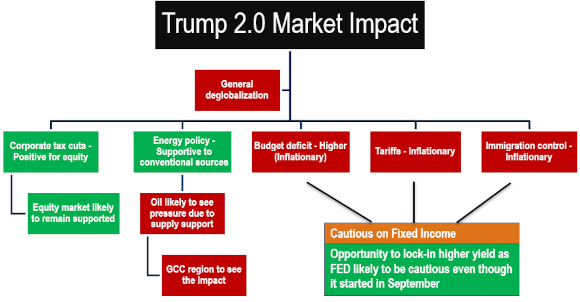
Trump2O Market Impact


Donald Trump is poised to become the 47th President of the United States on January 20, 2025, likely accompanied by a majority in the Senate and potentially a majority in the House of Representatives – a scenario commonly referred to as a “clean sweep.” Financial markets have responded as anticipated, with positive movement in U.S. equities, higher U.S. Treasury yields, and a stronger dollar.

While the short-term reaction is positive for most U.S. risk assets, the medium-term trajectory may not be as straightforward. As the political dust settles, markets will begin to focus on the new president’s capacity and fiscal flexibility to deliver campaign promises, particularly in areas like tariffs and tax cuts. The tariff implementation is anticipated to be staggered, depending on potential retaliatory tariffs from other countries, while immigration reforms, generally less complex to enact, are likely to be prioritized.

Trump 2.0 calls for an accelerated deglobalization, imposing tariffs and tighter labor mobility, a recipe for slower growth and higher inflation. Consensus estimates a 1.5% decline in GDP coupled with a 1.0% uptick in inflation within the first 12 months assuming President Trump opts to fully deliver on his campaign promises.

Corporate tax cuts, if enacted as suggested during the campaign, would be highly favorable for equities. We believe the potential for corporate tax rates to drop as low as 15% is yet to be fully priced in. However, the timing of such tax cuts will depend on the fiscal capacity and bond market tolerance,making this an ongoing source of equity market volatility in the near term. That said, U.S. earnings momentum remains supportive for equity markets over the medium term.

A combination of campaign promises on tariffs, immigration controls, and possibly larger deficits due to tax cuts is likely to be structurally inflationary. This scenario could present a challenge for the Federal Reserve, caught between potentially slower growth and higher inflation, which could lead to volatile bond markets. Additionally, it will be interesting to see if he goes ahead with the White House having a say in the Fed’s monetary policy decisions. Our sense is that he’ll avoid interference; however, any attempt to do so would likely create higher volatility in the fixed income market.

More specifically, the Middle East is likely to feel the heat during Trump 2.0 due to shifts in energy and geopolitical policies. Known for his pro-fossil-fuel stance, Trump’s administration is likely to scale back support for alternative energy, which would initially benefit U.S.-based oil companies. His push to end the Russia-Ukraine war could reintroduce significant volumes of Russian oil to global markets, potentially putting downward pressure on oil prices. Additionally, the Trump administration’s stance towards Iran may heighten tensions in an already volatile region, further impacting the geopolitical landscape and possibly influencing oil market volatility.

For more information on how we can navigate your investment portfolio during Trump 2.0 (and beyond), please get in touch with our Chief Investment Officer, Ali Taqi, CFA.

Beyond balancing the books

Image1

Beyond balancing the books


What are the investment implications of Labour’s Autumn Budget?

Drawing on information taken from the Commons Library Research Briefing: Autumn Budget 2024 Summary, the OBR’s October 2024 Economic and Fiscal Outlook, and the Financial Times, this analysis unpacks the potential implications of Labour’s fiscal adjustments on investment strategies. 

The 2024 Autumn Budget, Labour’s first fiscal outline in over 14 years, reflects a shift in the UK’s economic priorities. It introduces adjustments to employer National Insurance rates, revisions to capital gains tax thresholds, and significant infrastructure investments. These initiatives are positioned to address socioeconomic needs and support public service renewal, aligning with Labour’s vision for sustainable growth and equitable resource distribution.

For investors, understanding the implications of these fiscal changes is crucial. Key areas likely to see an impact include real estate, private equity, infrastructure, and ESG-focused assets, with potential shifts in value as policies take effect. Specifically, changes to employer taxation may influence corporate strategies, particularly in capital-intensive sectors, while capital gains tax adjustments could reshape investment planning.

We consider the UK’s upcoming fiscal adjustments and the potential impact on investment strategies.


Key Fiscal and Policy Shifts Impacting Business and Investment

National Insurance Contributions (NICs) and their implications for cost structures and employment strategies

Employer NICs will see a rate hike from 13.8% to 15% effective April 2025. Additionally, the NIC threshold will be reduced from £9,100 to £5,000, which the Treasury projects to generate approximately £25 billion in annual revenue. While the government has increased the employment allowance to help smaller firms offset the rise, larger firms and labour-intensive industries are likely to experience elevated operational costs.

This policy change may encourage businesses to reevaluate workforce structures and explore greater automation to offset increased payroll burdens. For investment in labour-intensive sectors, such as manufacturing, retail, and hospitality, the higher NICs could marginally affect profitability ratios. Companies that qualify for the expanded employment

allowance may find opportunities to optimise their workforce models, especially in low-margin industries.

For private equity investors, these developments underscore the importance of due diligence on payroll structures and overhead costs in target companies. Cost-benefit assessments around workforce automation and outsourcing may also become more common in strategic decision-making.

Capital Gains Tax (CGT) and Inheritance Tax (IHT) will potentially have long-term wealth planning implications

The budget’s adjustments to capital gains and inheritance taxes could have some implications for asset sales, estate planning, and corporate structuring, especially for high-net-worth individuals and family businesses. Effective immediately, CGT rates rise from 10% to 18% (lower) and from 20% to 24% (higher). The Business Asset Disposal Relief (BADR) and Investors’ Relief (IR) rates will similarly increase, gradually rising through 2025 and 2026.

On inheritance tax, as of April 2027, adjustments will apply to pension wealth that is transferable at death, expected to raise £1.5 billion annually. Meanwhile, business property relief (BPR) will be restructured, offering 100% relief on assets valued under £1 million but reducing relief to 50% on higher values. These adjustments could lead to a notable shift in estate planning strategies, especially for investors with significant agricultural or business holdings.

Family offices and trust structures may need to implement alternative tax mitigation strategies, such as offshore holdings, which align with new tax thresholds. The new policies on stamp duty and CGT seem to favour institutional ownership of real estate assets over direct owners. Therefore, we might see a move towards larger institutional ownership of UK real estate as is the case in the US for example. For private equity investors and real estate portfolios, this alignment would intensify tax burdens and may prompt accelerated exit strategies or restructured holdings to mitigate higher outflows. Here again, real estate investment trusts (REITs) offer distinct advantages over direct ownership of real estate.

Labour’s commitment to enforcing tighter regulations around non-domiciled individuals includes plans to subject offshore assets held in trusts to inheritance tax, a move expected to generate significant additional revenue. This measure specifically targets the practice of using offshore structures to shield wealth from UK taxation. Additionally, Labour’s policy aims to reduce tax exemptions that have historically allowed wealthy non-doms to avoid taxation on overseas income. By implementing these adjustments, Labour anticipates

curtailing some tax advantages that have previously attracted high-net-worth individuals to the UK. As these benefits are reduced, investment inflows, particularly in prime property and luxury asset markets, may see slower growth, potentially impacting high-value, cross-border investment strategies.


Public Sector Spending and Infrastructure Investment Open New Avenues

Infrastructure investment and ESG opportunities

The budget allocates one-third of its spending increase to infrastructure, covering sectors such as transport, housing, and research and development. Specifically, the National Wealth Fund will channel funds into projects supporting green energy, housing, and road maintenance, contributing to long-term GDP growth over the next 50 years. Additionally, the Department for Transport will receive investment increases aimed at advancing local road maintenance and public transport initiatives.

For real estate investors, heightened government spending on affordable housing could signal increased demand for increased demand for private investment in the affordable housing sector housing sector. With an additional £500 million earmarked for the Affordable Homes Programme and a CPI+1% indexing of rents, there is potential for increased private investment in affordable housing projects or for private equity funds targeting community housing developments. Aligning with these affordable housing initiatives can further support ESG-focused strategies, potentially tapping into social impact investment to bolster both return on investment and societal benefits. By taking part in affordable housing development, investors could enhance community impact while addressing a growing demand for low-cost housing solutions. From an ESG standpoint, green energy and carbon-neutral projects backed by National Wealth Fund investment align with market demand for sustainable investment vehicles.


The Office for Budget Responsibility (OBR) Economic Forecasts

Exploring GDP growth, inflation, and their sectoral impacts and resilience factors

The OBR forecasts GDP growth to accelerate to 2.0% in 2025, before stabilising at approximately 1.5% through 2029. This growth trajectory, while moderate, indicates stability, though inflationary pressures are expected to linger above the 2% target until 2029, with a peak effect in 2026 at 2.7%.

Inflation persistence could place upward pressure on input costs, particularly in manufacturing, construction, and services. For investors, inflation-linked assets, such as infrastructure and utilities, may offer a measure of resilience against sustained inflation. For Rasmala, the strategy has been to invest in assets that can quickly adjust income for inflation, for example residential built-to-rent schemes or inflation-linked commercial leases tend to better protect portfolios against erosion of value. Increased employer NICs may exert secondary inflationary pressures as businesses adjust pricing structures to accommodate rising overheads, potentially leading to reduced profit margins in price-sensitive sectors.


Real Estate, Private Equity, and Private School VAT Adjustments

Investment optimisation strategies in real estate stamp duty and business rates

The stamp duty land tax (SDLT) for second homes has increased from 3% to 5%, which could temper the rate of new acquisitions in high-demand property markets, such as London. However, on the one hand it may create space for first-time buyers, but on the other hand it may also reduce the supply of rental accommodation and result in higher rents. Real estate investors may wish to assess short-term acquisition rates against potential longer-term rental returns, especially in regions with rental demand surges.

Labour may also consider incentive structures to encourage landlords to expand rental availability, counterbalancing stricter eviction policies and other tenant protections. Such incentives could involve tax reliefs or grants for landlords, stabilizing supply in the private rental market amid rising regulatory costs. Investors in the private rental market may wish to assess these incentives as part of a broader rental yield strategy.

For commercial real estate and private equity investors, business rate relief, capped at 40% for retail, hospitality, and leisure sectors in 2025, can offer strategic avenues for optimising operational expenses. Additionally, lower-rate business rates for retail and hospitality spaces starting in 2026 could encourage strategic repositioning within these sectors, possibly boosting valuations over time. Commercial investors might consider repositioning retail assets to take advantage of these shifts, maximizing value through rate relief.

VAT on Private Schools

Introducing a 20% VAT on private school fees marks a notable shift in the education sector, potentially affecting demand dynamics and, indirectly, the real estate market in areas with a high concentration of private schools. For real estate investments in proximity to such

institutions, analysing shifts in property demand and exploring diverse tenant pools may become more relevant as demand for private schooling potentially adjusts.


Strategic Implications for Investor Portfolios

Social Infrastructure

In the immediate aftermath of the speech, more attention has been focused on the revenue (i.e. tax) side of the budget speech, and not enough on the spending side. The budget carries with it a historic expansion of the NHS, and additional investment in social housing, education, infrastructure and green energy sectors. This is bound to open many avenues for private investment in social infrastructure sectors such as senior living, social housing, renewables, etc. There could be a case for renewed interest in long-income strategies in these areas.

Real estate

The increase in SDLT and CGT rates and the end of non-dom status will reduce the attractiveness of owning ‘second homes’. In the short-term, this will weigh somewhat on prices, particularly in London but in the longer term, it will reduce the availability of housing stock available for rent. Long-term investors may therefore capture the buying opportunity thus afforded.

Private equity and VC

Capitalizing on restructuring needs in response to increased NICs and CGT rates, private equity portfolios could explore acquisition targets where automation or offshoring can offset rising tax burdens. Companies in need of restructuring or looking to diversify revenue streams may align well with strategies focused on resilient sectors, such as technology, healthcare, and sustainable industries.

At the same time, an increase in carried interest rates to 32% may deter some UK-based PE managers or make them relocate to other jurisdictions.


Conclusion

The 2024 UK Autumn Budget provides a framework that emphasizes both immediate economic stability and long-term growth potential through strategic public investment. Aligning portfolios to capitalise on inflation-linked, ESG-compliant, and government-supported assets while adjusting for tax impacts in labour-intensive sectors positions the

firm for resilient, sustainable growth. This approach not only mitigates immediate fiscal pressures but aligns with future-oriented investment trends in a dynamic economic environment.


Important disclaimer

This note is prepared by Rasmala Investment Bank Limited (“RIBL”). RIBL is regulated by the Dubai Financial Services Authority (“DFSA”). RIBL products or services are only made available to customers who RIBL is satisfied meet the regulatory criteria to be a ” Professional Client”, as defined under the Rules and Regulations of the Dubai Financial Services Authority(“DFSA”).

Investment recommendations take into account both risk and expected return. We base our long-term fair value estimates on a fundamental analysis, after having taken perceived risks into consideration. We have conducted reasonable research to arrive at our investment recommendations and fair value estimates for a product mentioned in this presentation. Although the information in this presentation has been obtained from sources that RIBL believes to be reliable, we have not independently verified such information thus it may not be accurate or complete. RIBL does not represent or warrant, either expressly or impliedly, the accuracy or completeness of the information or opinions contained within this presentation and no liability whatsoever is accepted by RIBL or any other person for any loss howsoever arising, directly or indirectly, from any use of such information or opinions or otherwise arising in connection therewith. Matters of past performance in this document should not be taken as an indication or guarantee of future performance and RIBL makes no representation or warranty, express, implied or otherwise, regarding future performance. The market value of any security and estimated income may be affected by changes in economic, financial, (including, but not limited to, spot and forward interest), and political factors time to maturity, market conditions, and volatility and the credit quality of any issuer or reference issuer. Readers should understand that financial projections, fair value estimates and statements regarding future prospects may not be realized. All opinions and estimates included in this presentation constitute our judgment as of this date and are subject to change without notice.

RIBL and its group entities (together and separately, “Rasmala”) does and may seek to do business in securities covered in its presentation. As a result, users should be aware that the firm may have a conflict of interest that could affect the objectivity of this presentation. Investors should consider this presentation as only a single factor in making their investment decision. Rasmala and its respective employees, directors and officers shall not be responsible or liable for any liabilities, damages, losses,claims, causes of action, or proceedings (including without limitation indirect, consequential, special, incidental, or punitive damages) arising out of or in connection with the use of this presentation or any errors or omissions in its content.

The research analyst or analysts responsible for the content of this presentation certify that: (1) the views expressed and attributed to the research analyst or analysts in the presentation accurately reflect their personal opinion(s) about the subject securities and issuers and/or other subject matter as appropriate; and, (2) no part of his or her compensation was, is or will be directly or indirectly related to the specific recommendations or views contained in this presentation. Certain information contained in this presentation constitutes “forward-looking statements”, which can be identified by the use of forward-looking terminology such as “projected” or “estimated” or comparable terminology. Due to various risks and uncertainties, actual events or results or the actual performance of the Market may differ materially from those reflected or contemplated in such forward-looking statements.

For Residents of Sultanate of Oman

The information contained in this presentation neither constitutes a public offer of securities in the Sultanate of Oman as contemplated by the Commercial Companies Law of Oman (Sultani Decree 4/74) or the Capital Market Law of Oman (Sultani Decree 80/98), nor does it constitute an offer to sell, or the solicitation of any offer to buy, non-Omani securities in the Sultanate of Oman (as contemplated by Article 6 of the Executive Regulations to the Capital Market Law – issued pursuant to Ministerial Decision No.4/2001). Additionally, this presentation is not intended to lead to the conclusion of a contract of any nature whatsoever within the territory of the Sultanate of Oman.

For Residents of the Kingdom of Saudi Arabia

This presentation does not, and is not intended to, constitute an invitation or an offer of securities in the Kingdom of Saudi Arabia (“Saudi Arabia”) and accordingly should not be construed as such. This presentation is being issued outside Saudi Arabia to a limited number of investors (a) upon their request and confirmation that they understand that the securities (i) are not for sale in Saudi Arabia, (ii) have not been approved, licensed, registered or qualified as exempt offers or private placements by or with the Saudi Arabian Capital Market Authority or any other relevant licensing authorities or governmental agencies in Saudi Arabia, (iii) are not listed on any stock market in Saudi Arabia, (iv) are not denominated in Saudi Riyals and movements in exchange rate may cause the value of the securities to diminish, and (v) past performance is no guarantee of future returns; and (b) on the condition that it will not be provided to any person other than the original recipient, is not for circulation in Saudi Arabia and may not be reproduced or used for any other purpose.

For Residents of The Arab Republic of Egypt

All applications for investment should be received and any allotments made, from outside Egypt. This presentation has been prepared for information purposes of intended investors only. This presentation will not be issued, passed to, or made available to the public generally.

For Residents of the United Kingdom

The contents of this presentation have not been approved by an authorised person for the purposes of Section 21 of the Financial Services Markets Act 2000 (“FSMA”). Accordingly, this presentation is being distributed only to persons who fall within an exemption to Section 21 of FSMA, under the following Articles of the Financial Services Markets Act 2000 (Financial Promotion) Order 2001: Articles 12 (overseas recipients), Articles 19 (investment professionals), Article 48 (high net worth individuals) and Article 50 (sophisticated investors). This presentation is directed solely at persons who fall within such exemptions who are also wholesale customers and not “Retail Customers” (both as defined under the Rules and Regulations of the DIFC) and must not be acted on or relied on by any other persons.

For Residents of the United Arab Emirates

This presentation does not, and is not intended to, constitute an invitation or an offer of securities in the United Arab Emirates (including the Dubai International Financial Centre) and accordingly should not be construed as such. This presentation is being issued to a limited number of institutional / sophisticated investors (a) upon their request and confirmation that they understand that the securities and the interests have not been approved or licensed by or registered with the United Arab Emirates Central Bank or any other relevant licensing authorities or governmental agencies in the United Arab Emirates; and (b) on the condition that it will not be provided to any person other than the original recipient, is not for general circulation in the United Arab Emirates and may not be reproduced or used for any other purpose.

For Residents of the State of Qatar

This document has not been filed with, reviewed or approved by the Qatar Central Bank, Qatar Financial Centre Regulatory Authority or any other relevant Qatari governmental body or security exchange.

For Residents of the Republic of Turkey

Neither this presentation nor any part of this should be utilized in connection with any general offering to the public in the Republic of Turkey without the prior approval of the Capital Markets Board of Turkey.

For Residents of the Kingdom of Bahrain

This presentation has been prepared for private information purposes and is intended to high-net-worth individuals and institutions. The Central Bank of Bahrain (“CBB”) has not reviewed, nor has it approved this presentation.

For Residents of the State of Kuwait

This presentation will comply with the provisions of law no 31 of 1990 as amended, entitled “Regulating Securities Offering and Sales” and its Executive By-laws (or implementing regulations) and other applicable laws and regulations in Kuwait. This presentation is issued outside Kuwait and should not be construed as public offer. The recipient of this material have been individual selected and is exclusively directed for private placement.

For Residents of the United States of America

RIBL is not registered with the U.S. Securities and Exchange Commission, or any U.S. state authority, as a broker-dealer or investment advisor. The securities of the funds referred to in this presentation have not been approved, disapproved or recommended by the U.S. Securities and Exchange Commission, any state securities commission in the United States, the securities commission of any non-U.S. jurisdiction or any other U.S. or non-U.S. regulatory authority. None of these

authorities has passed on or endorsed the merits of any offering of such securities or the accuracy or adequacy of this presentation. Any representation to the contrary is a criminal offence in the United States and may be a criminal offence in other jurisdictions.

The funds referred to herein have not been registered under the U.S. Investment Company Act of 1940. The securities of the funds referred to herein have not been and will not be registered under the U.S. Securities Act of 1933 or any state securities laws in the United States and may not be offered or sold in the United States except pursuant to an exemption from, or in a transaction not subject to, the registration requirements of the U.S. Securities Act of 1933 and Investment Company Act of 1940 and in accordance with any applicable U.S. state securities laws.

Rasmala’s Opinion – Rate Cuts with a Twist

fed 1

Inside the Fed’s Unusual Easing Cycle

31 October 2024The Federal Reserve (Fed) kicked off a much-anticipated monetary easing cycle with a “front-loaded” 50 basis point cut, signaling the potential for further reductions this year and perhaps more to come next year. Historically, easing cycles follow predictable patterns, such as signals for more rate cuts, a downward shift in the yield curve, and bond markets responding positively as investors extend their duration exposure in anticipation of capital gains. Yet this cycle is breaking away from tradition, defying past expectations.

Here’s why we think that this time, the story is different.

Summary

  • No Clear Slowdown: Unlike past cycles, this one lacks consensus on an economic slowdown, with GDP growth remaining strong and fiscal stimulus at 5%-6%.
  • Advanced Signaling: Tools like dot plots and press conferences are now central, shaping rate expectations more clearly and reducing uncertainty.
  • Rising Neutral Rate: The neutral rate (r*), the theoretical interest rate that neither accelerates nor slows down the economy, is trending upward, signaling stronger growth and a relatively more resilient economy than before.
  • Yield Curve Shift: We may see a “bear steepener”, a scenario where long-term interest rates rise faster than short-term rates. Unlike typical easing cycles, where rates across all maturities generally fall, a bear steepener suggests stronger economic growth or rising inflation, even as the Fed cuts short-term rates.

Easing Without Slowdown: What Sets This Cycle Apart

The Fed’s latest easing cycle began amidst a significant deviation from historical patterns lacking a clear consensus on the economic outlook. Typically, when the Fed initiates a series of rate cuts, the market has already braced for an economic slowdown. A high probability of slower growth is generally priced in. This time around, however, such a consensus is conspicuously absent.

GDP growth remains strong, with the economy registering a robust 3% growth rate last quarter and similar expectations for the current quarter. This growth contradicts expectations of a slowdown. With fiscal stimulus at 5%-6% of GDP, a near-term downturn seems unlikely. As a result, the economy is showing more resilience than in previous cycles, challenging the notion that we are entering a period of widespread deceleration.

Dot Plots and Press Conferences: Reshaping the Narrative

Another defining feature of this cycle is the Fed’s use of more advanced signaling tools, like the dot plots and more detailed press conferences. Introduced in 2012, dot plots provides projections for future interest rates over time, offering the market forward guidance about the Fed’s intentions. While these tools were utilised in the post-Global Financial Crisis (GFC) era, they weren’t available during earlier easing cycles, nor did they shape the initial phases of the GFC response.

Historically, the bond market often faced uncertainty about the direction of rates, leading to delayed adjustments. For instance, in the GFC, the market had no foresight that rates would plunge to zero and stay there for an extended period. The dot plot’s primary role has been to establish a clearer trajectory for interest rates over the next few years, aiming to anchor market expectations more effectively. Consequently, longer-term yields have adjusted more quickly. These tools signal a shift in how the Fed manages market expectations.

r for Reassessment: What a Higher Neutral Rate Means for Investors

The concept of the neutral rate (r*) has played a pivotal role in shaping expectations during this easing cycle. Traditionally, r* trends downward as the economy slows. However, the current cycle is marked by a notable upward trend in r*, signaling stronger underlying growth.

In September, seven members of the Federal Open Market Committee (FOMC) projected the neutral rate to be 3.25% or higher, up from just four members in June. This suggests the Fed anticipates a higher equilibrium rate, given solid economic growth and a substantial “twin deficit” (a combination of fiscal and trade deficits). Unlike previous cycles, where falling r* aligned with economic slowdown, this time the neutral rate appears more resilient, driven by structural factors that imply longer-term economic strength.

The rising neutral rate also affects other markets. Equities, for instance, might benefit from lower short-term rates, but valuations will need to reflect the reality of higher long-term yields and sustained economic growth. Investors may find that, despite lower short-term borrowing costs, the higher neutral rate could exert upward pressure on longer-term yields, posing challenges for sectors sensitive to rate changes. These changes further affect how investors perceive yield curve dynamics.

US Treasury

Source: US Treasury

See Beyond the Bull: This Cycle Challenges Convention

Historically, Fed easing cycles have been associated with a “bull steepener” in the yield curve. In this scenario, short-term rates fall rapidly in response to rate cuts, while long-term rates decline more gradually, reflecting expectations of a slowing economy and lower terminal rates. This time, however, the narrative is shifting. The current yield curve behavior hints at the possibility of a “bear steepener”, where long-term yields rise despite short-term rate cuts.

With economic growth remaining robust and the neutral rate trending upwards, the longer end of the curve may not decline as sharply as it did in past cycles. In essence, investors may have to contend with higher long-term yields, driven by sustained economic strength and the Fed’s ongoing signaling of a higher terminal rate.

This potential shift in yield curve dynamics underscores broader implications for the real economy. While businesses and consumers may enjoy some relief from lower short-term rates, longer-term borrowing costs could remain elevated. This scenario might temper investment and spending, even as the Fed continues its easing.

Final Thoughts

This Fed cycle breaks from tradition in crucial ways, marked by a strong economy, the full utilisation of monetary policy signaling tools, rising neutral rate expectations, and shifting yield curve dynamics. As markets grapple with these changes, the path forward may be more complex than usual. While easing cycles traditionally offer more straightforward signals for investors, this cycle invites caution, requiring a deeper understanding of the evolving economic landscape.

This Fed cycle could redefine how investors perceive the central bank’s playbook, an evolution that could have long-lasting implications. Successfully navigating this evolving landscape will demand both agility and insight.

Contact

For more information, please contact:
Rasmala Media
+971 4 3635600
media@rasmala.com


About the Rasmala Group

Rasmala Group is a leading alternative investment manager operating in global markets since 1999. It invests directly and alongside Gulf-based institutional investors including banks, pension funds, endowments, family offices, corporations, and government institutions. Rasmala Investment Bank Limited (RIBL) is based in the Dubai International Financial Centre and regulated by the Dubai Financial Services Authority (DFSA) and is a wholly owned subsidiary of the Rasmala Group.
For further details, please visit www.rasmala.com.

Important Disclaimer:

This note is prepared by Rasmala Investment Bank Limited (“RIBL”). RIBL is regulated by the Dubai Financial Services Authority (“DFSA”). RIBL products or services are only made available to customers who RIBL is satisfied meet the regulatory criteria to be a ” Professional Client”, as defined under the Rules and Regulations of the Dubai Financial Services Authority(“DFSA”).

Although the information in this presentation has been obtained from sources that RIBL believes to be reliable, we have not independently verified such information thus it may not be accurate or complete. RIBL does not represent or warrant, either expressly or impliedly, the accuracy or completeness of the information or opinions contained within this presentation and no liability whatsoever is accepted by RIBL or any other person for any loss howsoever arising, directly or indirectly, from any use of such information or opinions or otherwise arising in connection therewith. Matters of past performance in this document should not be taken as an indication or guarantee of future performance and RIBL makes no representation or warranty, express, implied or otherwise, regarding future performance.

The market value of any security and estimated income may be affected by changes in economic, financial, (including, but not limited to, spot and forward interest), and political factors time to maturity, market conditions, and volatility and the credit quality of any issuer or reference issuer. Readers should understand that financial projections, fair value estimates and statements regarding future prospects may not be realized. All opinions and estimates included in this presentation constitute our judgment as of this date and are subject to change without notice. RIBL and its group entities (together and separately, “Rasmala”) does and may seek to do business in securities covered in its presentation. As a result, users should be aware that the firm may have a conflict of interest that could affect the objectivity of this presentation. Investors should consider this presentation as only a single factor in making their investment decision. Rasmala and its respective employees, directors and officers shall not be responsible or liable for any liabilities, damages, losses, claims, causes of action, or proceedings (including without limitation indirect, consequential, special, incidental, or punitive damages) arising out of or in connection with the use of this presentation or any errors or omissions in its content.

The research analyst or analysts responsible for the content of this presentation certify that: (1) the views expressed and attributed to the research analyst or analysts in the presentation accurately reflect their personal opinion(s) about the subject securities and issuers and/or other subject matter as appropriate; and, (2) no part of his or her compensation was, is or will be directly or indirectly related to the specific recommendations or views contained in this presentation. Certain information contained in this presentation constitutes “forward-looking statements”, which can be identified by the use of forward-looking terminology such as “projected” or “estimated” or comparable terminology. Due to various risks and uncertainties, actual events or results or the actual performance of the Market may differ materially from those reflected or contemplated in such forward-looking statements.

Rasmala’s Opinion – Rate Cuts with a Twist

wp3129793 investment wallpapers 1728x1080 1


Rasmala’s Opinion – Rate Cuts with a Twist

Inside the Fed’s Unusual Easing Cycle


fed 1 1


28 October 2024: The Federal Reserve (Fed) kicked off a much-anticipated monetary easing cycle with a “front-loaded” 50 basis point cut, signaling the potential for further reductions this year and perhaps more to come next year. Historically, easing cycles follow predictable patterns, such as signals for more rate cuts, a downward shift in the yield curve, and bond markets responding positively as investors extend their duration exposure in anticipation of capital gains. Yet this cycle is breaking away from tradition, defying past expectations.

Here’s why we think that this time, the story is different.

Summary

  • No Clear Slowdown: Unlike past cycles, this one lacks consensus on an economic slowdown, with GDP growth remaining strong and fiscal stimulus at 5%-6%.
  • Advanced Signaling: Tools like dot plots and press conferences are now central, shaping rate expectations more clearly and reducing uncertainty.
  • Rising Neutral Rate: The neutral rate (r*), the theoretical interest rate that neither accelerates nor slows down the economy, is trending upward, signaling stronger growth and a relatively more resilient economy than before.
  • Yield Curve Shift: We may see a “bear steepener”, a scenario where long-term interest rates rise faster than short-term rates. Unlike typical easing cycles, where rates across all maturities generally fall, a bear steepener suggests stronger economic growth or rising inflation, even as the Fed cuts short-term rates.

Easing Without Slowdown: What Sets This Cycle Apart

The Fed’s latest easing cycle began amidst a significant deviation from historical patterns lacking a clear consensus on the economic outlook. Typically, when the Fed initiates a series of rate cuts, the market has already braced for an economic slowdown. A high probability of slower growth is generally priced in. This time around, however, such a consensus is conspicuously absent.

GDP growth remains strong, with the economy registering a robust 3% growth rate last quarter and similar expectations for the current quarter. This growth contradicts expectations of a slowdown. With fiscal stimulus at 5%-6% of GDP, a near-term downturn seems unlikely. As a result, the economy is showing more resilience than in previous cycles, challenging the notion that we are entering a period of widespread deceleration.

Dot Plots and Press Conferences: Reshaping the Narrative

Another defining feature of this cycle is the Fed’s use of more advanced signaling tools, like the dot plots and more detailed press conferences. Introduced in 2012, dot plots provides projections for future interest rates over time, offering the market forward guidance about the Fed’s intentions. While these tools were utilised in the post-Global Financial Crisis (GFC) era, they weren’t available during earlier easing cycles, nor did they shape the initial phases of the GFC response.

Historically, the bond market often faced uncertainty about the direction of rates, leading to delayed adjustments. For instance, in the GFC, the market had no foresight that rates would plunge to zero and stay there for an extended period. The dot plot’s primary role has been to establish a clearer trajectory for interest rates over the next few years, aiming to anchor market expectations more effectively. Consequently, longer-term yields have adjusted more quickly. These tools signal a shift in how the Fed manages market expectations.

r for Reassessment: What a Higher Neutral Rate Means for Investors

The concept of the neutral rate (r*) has played a pivotal role in shaping expectations during this easing cycle. Traditionally, r* trends downward as the economy slows. However, the current cycle is marked by a notable upward trend in r*, signaling stronger underlying growth.

In September, seven members of the Federal Open Market Committee (FOMC) projected the neutral rate to be 3.25% or higher, up from just four members in June. This suggests the Fed anticipates a higher equilibrium rate, given solid economic growth and a substantial “twin deficit” (a combination of fiscal and trade deficits). Unlike previous cycles, where falling r* aligned with economic slowdown, this time the neutral rate appears more resilient, driven by structural factors that imply longer-term economic strength.

The rising neutral rate also affects other markets. Equities, for instance, might benefit from lower short-term rates, but valuations will need to reflect the reality of higher long-term yields and sustained economic growth. Investors may find that, despite lower short-term borrowing costs, the higher neutral rate could exert upward pressure on longer-term yields, posing challenges for sectors sensitive to rate changes. These changes further affect how investors perceive yield curve dynamics.

US Treasury

Source: US Treasury

See Beyond the Bull: This Cycle Challenges Convention

Historically, Fed easing cycles have been associated with a “bull steepener” in the yield curve. In this scenario, short-term rates fall rapidly in response to rate cuts, while long-term rates decline more gradually, reflecting expectations of a slowing economy and lower terminal rates. This time, however, the narrative is shifting. The current yield curve behavior hints at the possibility of a “bear steepener”, where long-term yields rise despite short-term rate cuts.

With economic growth remaining robust and the neutral rate trending upwards, the longer end of the curve may not decline as sharply as it did in past cycles. In essence, investors may have to contend with higher long-term yields, driven by sustained economic strength and the Fed’s ongoing signaling of a higher terminal rate.

This potential shift in yield curve dynamics underscores broader implications for the real economy. While businesses and consumers may enjoy some relief from lower short-term rates, longer-term borrowing costs could remain elevated. This scenario might temper investment and spending, even as the Fed continues its easing.

Final Thoughts

This Fed cycle breaks from tradition in crucial ways, marked by a strong economy, the full utilisation of monetary policy signaling tools, rising neutral rate expectations, and shifting yield curve dynamics. As markets grapple with these changes, the path forward may be more complex than usual. While easing cycles traditionally offer more straightforward signals for investors, this cycle invites caution, requiring a deeper understanding of the evolving economic landscape.

This Fed cycle could redefine how investors perceive the central bank’s playbook, an evolution that could have long-lasting implications. Successfully navigating this evolving landscape will demand both agility and insight.

Contact

For more information, please contact:
Rasmala Media
+971 4 3635600
media@rasmala.com


About the Rasmala Group

Rasmala Group is a leading alternative investment manager operating in global markets since 1999. It invests directly and alongside Gulf-based institutional investors including banks, pension funds, endowments, family offices, corporations, and government institutions. Rasmala Investment Bank Limited (RIBL) is based in the Dubai International Financial Centre and regulated by the Dubai Financial Services Authority (DFSA) and is a wholly owned subsidiary of the Rasmala Group.
For further details, please visit www.rasmala.com.

Important Disclaimer:

This note is prepared by Rasmala Investment Bank Limited (“RIBL”). RIBL is regulated by the Dubai Financial Services Authority (“DFSA”). RIBL products or services are only made available to customers who RIBL is satisfied meet the regulatory criteria to be a ” Professional Client”, as defined under the Rules and Regulations of the Dubai Financial Services Authority(“DFSA”).

Although the information in this presentation has been obtained from sources that RIBL believes to be reliable, we have not independently verified such information thus it may not be accurate or complete. RIBL does not represent or warrant, either expressly or impliedly, the accuracy or completeness of the information or opinions contained within this presentation and no liability whatsoever is accepted by RIBL or any other person for any loss howsoever arising, directly or indirectly, from any use of such information or opinions or otherwise arising in connection therewith. Matters of past performance in this document should not be taken as an indication or guarantee of future performance and RIBL makes no representation or warranty, express, implied or otherwise, regarding future performance.

The market value of any security and estimated income may be affected by changes in economic, financial, (including, but not limited to, spot and forward interest), and political factors time to maturity, market conditions, and volatility and the credit quality of any issuer or reference issuer. Readers should understand that financial projections, fair value estimates and statements regarding future prospects may not be realized. All opinions and estimates included in this presentation constitute our judgment as of this date and are subject to change without notice. RIBL and its group entities (together and separately, “Rasmala”) does and may seek to do business in securities covered in its presentation. As a result, users should be aware that the firm may have a conflict of interest that could affect the objectivity of this presentation. Investors should consider this presentation as only a single factor in making their investment decision. Rasmala and its respective employees, directors and officers shall not be responsible or liable for any liabilities, damages, losses, claims, causes of action, or proceedings (including without limitation indirect, consequential, special, incidental, or punitive damages) arising out of or in connection with the use of this presentation or any errors or omissions in its content.

The research analyst or analysts responsible for the content of this presentation certify that: (1) the views expressed and attributed to the research analyst or analysts in the presentation accurately reflect their personal opinion(s) about the subject securities and issuers and/or other subject matter as appropriate; and, (2) no part of his or her compensation was, is or will be directly or indirectly related to the specific recommendations or views contained in this presentation. Certain information contained in this presentation constitutes “forward-looking statements”, which can be identified by the use of forward-looking terminology such as “projected” or “estimated” or comparable terminology. Due to various risks and uncertainties, actual events or results or the actual performance of the Market may differ materially from those reflected or contemplated in such forward-looking statements.

Subscribe to Our Newsletter

Stay updated with the latest news and updates from our team.

Contact Our Team

For personalised solutions and expert guidance tailored to your investment goals, call us at +9714 424 2700

Request a Call Back