
US Rates Outlook: Why the Fed Is Staring Past the Oil Rally
Rasmala Market Commentary — July 2026
With the FOMC meeting under the new Chair and the MoU between the US and Iran now behind us, where is the US yield curve heading?
A Yield Curve That Won’t Cooperate
The US and Iran have signed an MoU, which has resulted in oil prices moving back close to pre-war levels. This should, in theory, have brought the US yield curve back towards pre-war levels as well, even if not entirely. However, the curve has barely moved: the short end remains up by almost 75bps, while the long end is up by around 30bps relative to pre-war levels, which is a pattern consistent with bear flattening. Although the oil price increase had not fully unwound by the time Kevin Warsh spoke, the new FOMC Chair sounded more hawkish in his first press conference than the market had expected.

Source: Bloomberg
Inflation Runs Deeper Than Oil
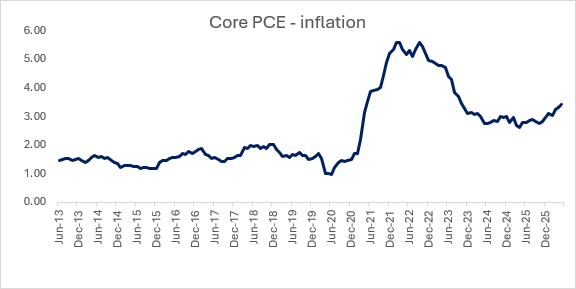
These two events suggest that the inflation story runs much deeper than oil alone. Core PCE, historically the Fed’s preferred inflation measure, turned around in October last year and crossed above the 3% mark in December. On closer inspection, there is no evidence that energy prices alone are driving inflation higher: Healthcare and Housing, which together account for 36% of the core PCE index, contributed 1.2 percentage points of the 3.4% print for May, while Financial Services & Insurance, with a weight of less than 9% in the index, contributed 0.7 percentage points. Super core PCE, which strips out housing-related inflation from the core index, has been running consistently above 3%; the latest print was 3.9%, up 0.6 percentage points from its recent low of 3.2% in October 2025.
Source: Bloomberg
The Labour Market Regains Its Footing
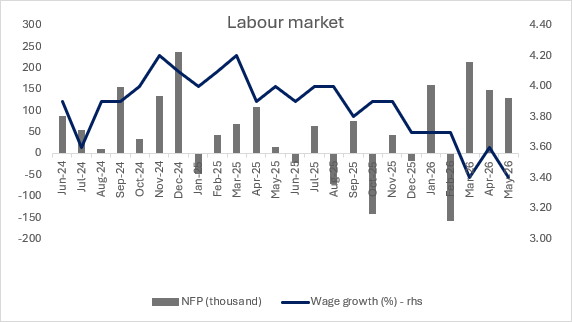
On the other side, the labour market is regaining momentum, with payrolls averaging 188k over the last three months. Strong payroll growth has been witnessed in cyclical industries such as Leisure & Hospitality, followed by non-cyclical sectors such as Education & Health Services. Given the tight US labour supply resulting from the changed immigration environment, it is not unreasonable to expect wage growth, which has been moderating over the past year, to turn around.
Source: Bloomberg
Structural Growth: The AI Capex Story
Beyond the high-frequency data on inflation and the labour market, we see strong structural growth underpinned by a massive capex cycle in AI-related industries, high government spending, and robust consumer spending supported by a low unemployment rate and the wealth effect. To put this in perspective, gross private domestic investment contributed 1.35 percentage points of the 2.1% GDP growth recorded in Q1 2026. Adjusting for the change in inventories and the decline in residential investment, the contribution from non-residential capex was even higher. Given the scale of ongoing AI-related spending, we expect the capex cycle to be sustained over the medium term.
Our Outlook: On Hold, With Hike Risk Skewed Higher
It is therefore unsurprising that the market has largely looked past the sharp decline in the oil price following the MoU between the US and Iran. The market still expects at least one rate hike from the Fed by year-end. Our baseline expectation, however, is that the Fed will remain on hold for an extended period. This view rests on the fact that the US economy currently sits on a strong footing, though much will also depend on how AI-related capex evolves in the second half of this year and into next. That said, we believe the probability of a rate hike is considerably higher than that of a rate cut when it comes to the Fed’s next move, particularly if it materialises within the next couple of quarters. Additionally, should a hike occur, it is likely to be more than a single move.