
Trump Makes History, Market Reacts Predictably
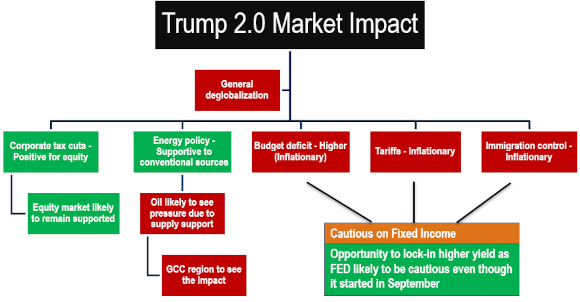
Donald Trump is poised to become the 47th President of the United States on January 20, 2025, likely accompanied by a majority in the Senate and potentially a majority in the House of Representatives – a scenario commonly referred to as a “clean sweep.” Financial markets have responded as anticipated, with positive movement in U.S. equities, higher U.S. Treasury yields, and a stronger dollar.
While the short-term reaction is positive for most U.S. risk assets, the medium-term trajectory may not be as straightforward. As the political dust settles, markets will begin to focus on the new president’s capacity and fiscal flexibility to deliver campaign promises, particularly in areas like tariffs and tax cuts. The tariff implementation is anticipated to be staggered, depending on potential retaliatory tariffs from other countries, while immigration reforms, generally less complex to enact, are likely to be prioritized.
Trump 2.0 calls for an accelerated deglobalization, imposing tariffs and tighter labor mobility, a recipe for slower growth and higher inflation. Consensus estimates a 1.5% decline in GDP coupled with a 1.0% uptick in inflation within the first 12 months assuming President Trump opts to fully deliver on his campaign promises.
Corporate tax cuts, if enacted as suggested during the campaign, would be highly favorable for equities. We believe the potential for corporate tax rates to drop as low as 15% is yet to be fully priced in. However, the timing of such tax cuts will depend on the fiscal capacity and bond market tolerance,making this an ongoing source of equity market volatility in the near term. That said, U.S. earnings momentum remains supportive for equity markets over the medium term.
A combination of campaign promises on tariffs, immigration controls, and possibly larger deficits due to tax cuts is likely to be structurally inflationary. This scenario could present a challenge for the Federal Reserve, caught between potentially slower growth and higher inflation, which could lead to volatile bond markets. Additionally, it will be interesting to see if he goes ahead with the White House having a say in the Fed’s monetary policy decisions. Our sense is that he’ll avoid interference; however, any attempt to do so would likely create higher volatility in the fixed income market.
More specifically, the Middle East is likely to feel the heat during Trump 2.0 due to shifts in energy and geopolitical policies. Known for his pro-fossil-fuel stance, Trump’s administration is likely to scale back support for alternative energy, which would initially benefit U.S.-based oil companies. His push to end the Russia-Ukraine war could reintroduce significant volumes of Russian oil to global markets, potentially putting downward pressure on oil prices. Additionally, the Trump administration’s stance towards Iran may heighten tensions in an already volatile region, further impacting the geopolitical landscape and possibly influencing oil market volatility.
For more information on how we can navigate your investment portfolio during Trump 2.0 (and beyond), please get in touch with our Chief Investment Officer, Ali Taqi, CFA.